Dr. Vivek Sukumar

What is minimal access surgery?

Traditionally, surgery is performed using a large open incision. Minimal invasive surgery includes laparoscopic and robotic surgery which use small incisions ( 5mm to 12mm ) to access the abdomen and thoracic cavity to perform surgeries.

What are the advantages of minimal invasive surgery?

Minimal Invasive surgery Open Surgery
Small Incisions Large Incisions
Minimal blood loss More blood loss
Minimal post-operative pain Significant post-operative pain
No difficulty in walking, coughing, exercising Difficulty in walking, coughing , exercising
Early recovery of bowel function Delayed bowel recovery
Shorter hospital stay Longer hospital stay

What is Laparoscopic surgery?

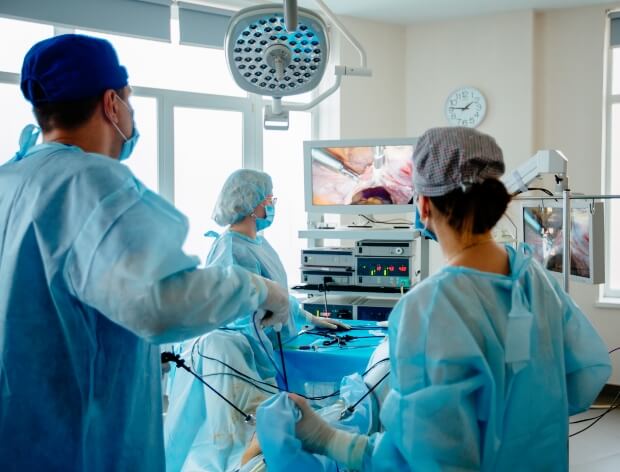
In laparoscopic surgery, the surgeon makes a small incision close to the belly button and inserts a laparoscopic trocar into the abdomen in a controlled manner. This trocar is a short tube through which instruments and camera can be inserted into the abdomen.
Once the trocar is inserted, a laparoscope (a thin long metallic tube with a camera) is inserted through it into the abdomen to confirm safe entry. Then abdomen is inflated with air or CO2 ( this is called “ pneumoperitoneum “ ).
This is necessary to create working space inside. After this step, few more trocars are inserted for instruments to perform surgery. Assistant holds the camera while the surgeon operates with two instruments. Sometimes a second assistant is also needed.
The number and placement of other trocars ( also called ports ) depends on the organ that is being operated upon.

What is Robotic surgery?

Can laparoscopy and robotic surgery be used in cancer?

Yes. There is enough scientific evidence to support the use of these methods in cancer surgery.
A valid fear in applying these techniques is about the oncological safety. Oncological safety is the ability to perform a cancer surgery that adheres to the prevailing surgical standards endorsed by experts and international guidelines. With proper training and experience this oncological safety can be achieved with laparoscopic and robotic surgeries as well. This has been proved with time and again by robust scientific research.

What cancers can be operated upon using these techniques?